
A conversation happens in almost every insurance transformation engagement, usually about six weeks before go-live. Somebody asks a question that should have been asked at the start:
“How are we actually validating that what’s in the new system is correct?”
The answers reveal one of the industry’s most persistent blind spots. QA and validation are consistently underfunded, under-resourced, and structurally mispositioned, treated as a final gate rather than a continuous discipline until the consequences become impossible to ignore.
The typical QA model is a compressed testing window near the launch milestone. Its job is to confirm that the platform works as intended. The problem is that’s the wrong question.
The right question is whether this platform, configured for this carrier, produces the correct outcomes across the specific policy types, endorsement patterns, billing arrangements, and exception scenarios that define this carrier’s actual book of business. Generic test scripts applied by teams unfamiliar with a carrier’s operations routinely miss the gap between those two questions. By the time the gap shows up in production, the project team has dispersed, and the carrier is managing the fallout alone.
Late QA also creates launch pressure that compromises rigor. When testing is compressed into the final weeks of a project, teams face a choice between delaying a go-live and absorbing the commercial and reputational cost or accepting known defects and managing them post-launch. Many choose the latter. Most regret it.
The carriers that navigate transformation cleanly treat QA as a discipline that runs in parallel with every stage of implementation. The components that matter:
Data integrity validation at every migration stage. Extraction, transformation, and loading each require systematic validation.
Carrier-specific scenario testing. A test library built from the carrier’s actual book of business: the policy types written most frequently, the endorsements issued most commonly, the billing arrangements in place with agents, and the claims scenarios adjusters encounter daily.
Financial reconciliation with parallel-run discipline. Running legacy and new billing systems simultaneously through at least one full cycle is the only reliable way to identify discrepancies before they affect policyholders.
AI output validation. As carriers deploy agentic AI platforms in which autonomous agents participate in underwriting, claims triage, and renewal decisions, the question of whether those agents produce reliable outputs on the converted dataset becomes a critical QA dimension.
Operational UAT with real scenarios. The people who will use the system daily are the most reliable detectors of workflow problems that technical QA won’t surface.
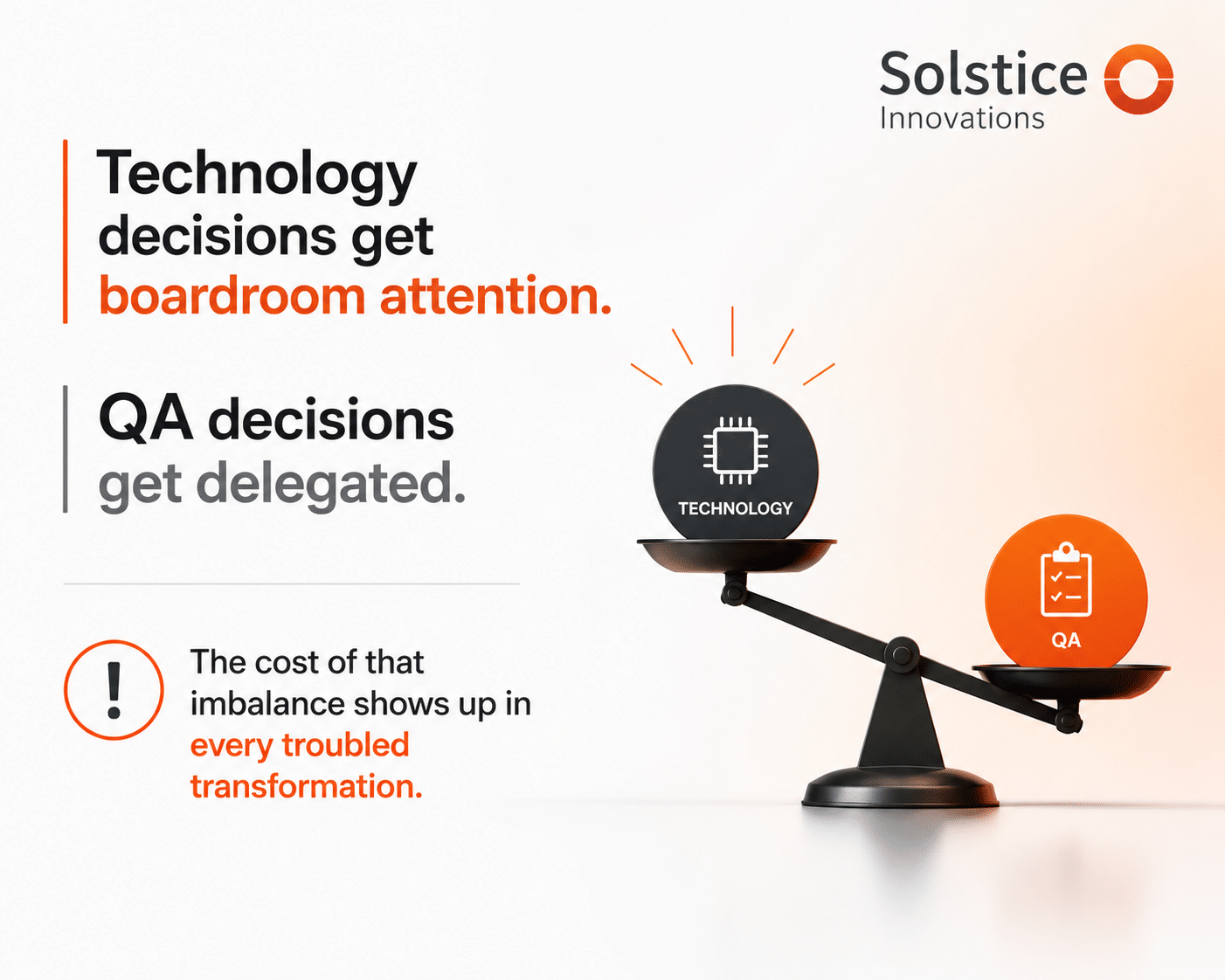
The carriers that convert successfully share a consistent pattern. They treat data preparation as a pre-conversion workstream, not a Too frequently, technology decisions get boardroom attention while QA decisions get delegated. The cost of that imbalance shows up in every troubled transformation. Don’t become another implementation statistic.
Make QA and validation a discipline from the start.
This post was written with the assistance of AI.
Solstice Innovations is not affiliated with the U.S. government or any federal flood or P&C insurance program. We are committed to protecting your privacy, as detailed in our Privacy Policy and Terms of Use. Solstice.tech is operated by Solstice Innovations LLC, a licensed brokerage specializing in flood and P&C insurance.